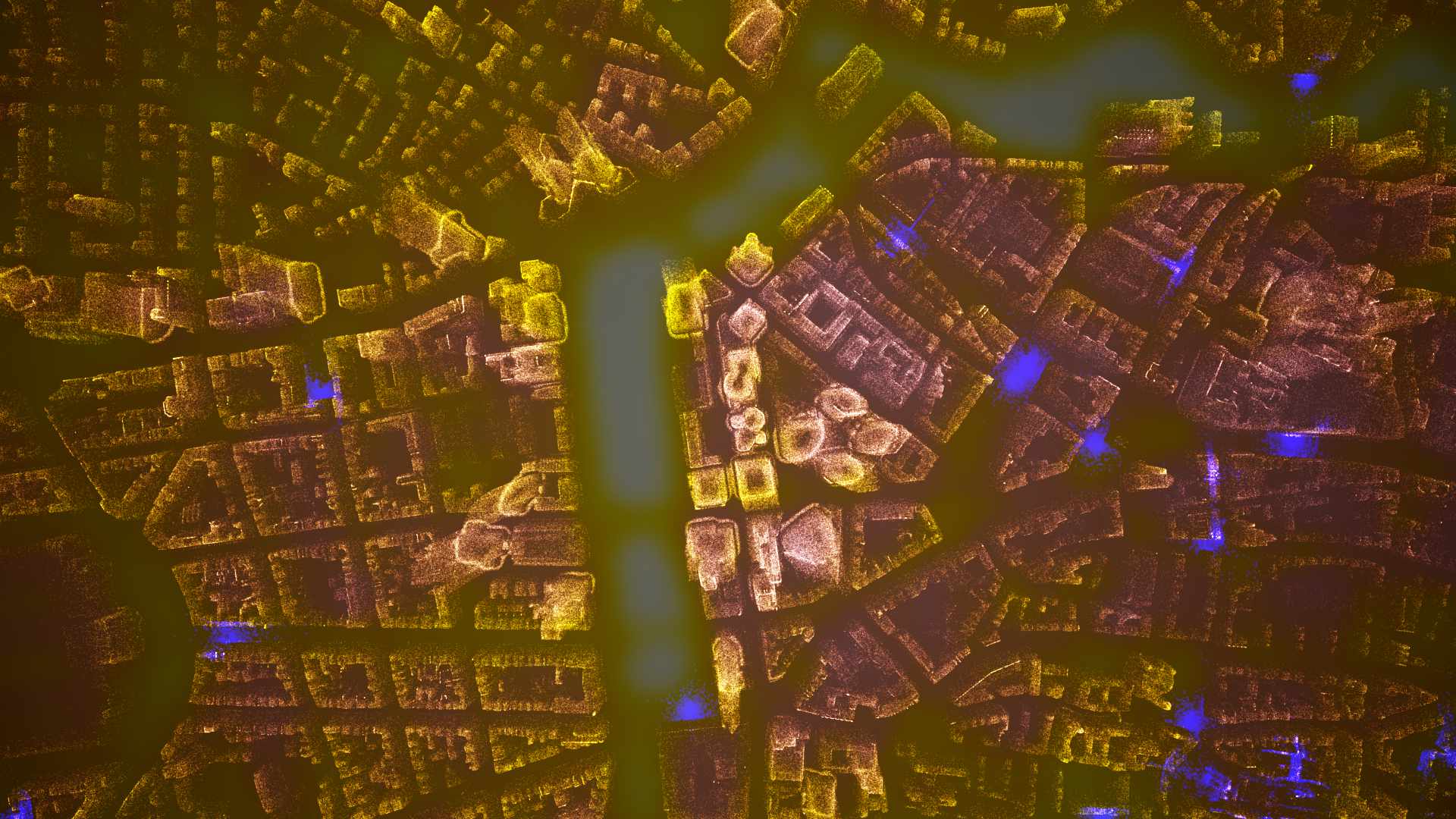
Shape real data into living, GPU-driven particle art.
1 Session at 3 hours, live in English language
Recordings will become available the day after the live lesson.
The high-resolution swarm aesthetics and behaviour of particles can be put to use to visualize data in a more dynamic way than graphs and timelines could. We want to get playful and experimental with it, but also look for ways to use these dense, physics-based and flowing characteristics to gain more information from datasets.
Map-based data and stream visualizations are our starting point, and from there it is up to you: besides color, mass/proportion and minimal shapes — the core ingredients of data vis — how and where would you integrate a particle system? Would you stir the swarm up with forces, let it expand and contract, or send it on its way at variable speed to get your story across?
Concretely, we build toward a particle artwork driven by geological data. Color maps exported from GIS software, rendered into 2D textures, become the control signals for your VL.Fuse particles — driving emission height, size, color and the forces acting on them. Layer in another dataset to drive another property, and the piece grows into a living, generative composition assembled from real data.
Working in an interactive, real-time, 3D and GPU-based environment, you can either make the final presentation interactive or use it as a playground to shape your data visualization like a sculpture. By the end you’ll have your own data-driven particle system — and the pipeline to point it at whatever dataset you bring next
What you will learn
- How you drive a particle system along specific geospatial data
- how GPU coding in vvvv works using VL.Fuse
- Setting up a particle system with VL.Fuse
- Input methods for data visualization in general and geospatial data specifically
- Bridging CPU land to GPU Shader land
- Shaping a particle system with data
Requirements
- Windows computer with latest vvvv gamma installed
- 3 button mouse recommended
- Second monitor recommended
- A dedicated / strong graphics card (VL.Fuse is GPU-heavy)
- VL.Fuse installed (see Setup below)