SP Grid
Foundations
For creative technologists who make installations and live shows. Learn to run sensors, light, sound and video from one system, Stage Precision’s SP Grid, in eight parts and at your own speed.
Register to be notified when the course goes on sale
What is SP Grid?
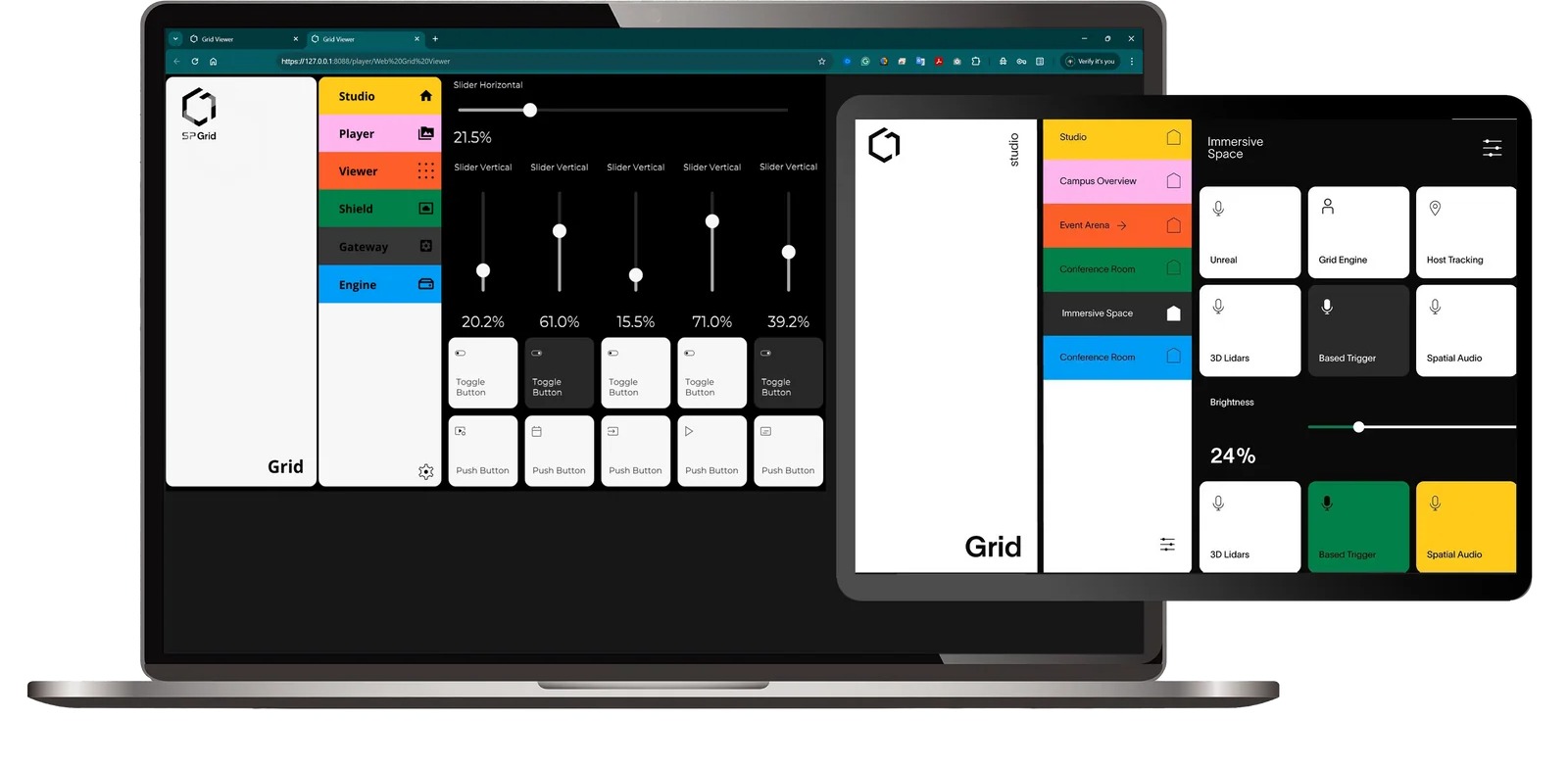
Stage Precision’s platform for connecting and controlling sensors, video, sound, light and machines in live shows and installations. You build the logic in Grid Studio. This course is made with the support of Stage Precision.
Made for creative technologists
You patch in TouchDesigner or vvvv, wire up microcontrollers or run media servers. Then a project gets bigger, with more devices, more cues and a venue technician who has to start it on Monday without you. This course teaches SP Grid for that situation.
You build control panels an operator can use, work with live data over OSC, write timelines and cue lists, script in Python and set up a state machine. Every week has a conversation, a hands-on tutorial and a quiz or homework.
Belçim, Sasha and Célestin are media artists who learned SP Grid to make this course, and you see how they got there, doubts included. From week 6 they build one piece together at Stage Precision. There are about ten and a half hours of video, and you go at your own speed. Quizzes, homework and your own patching come on top.
The Feedback Machine
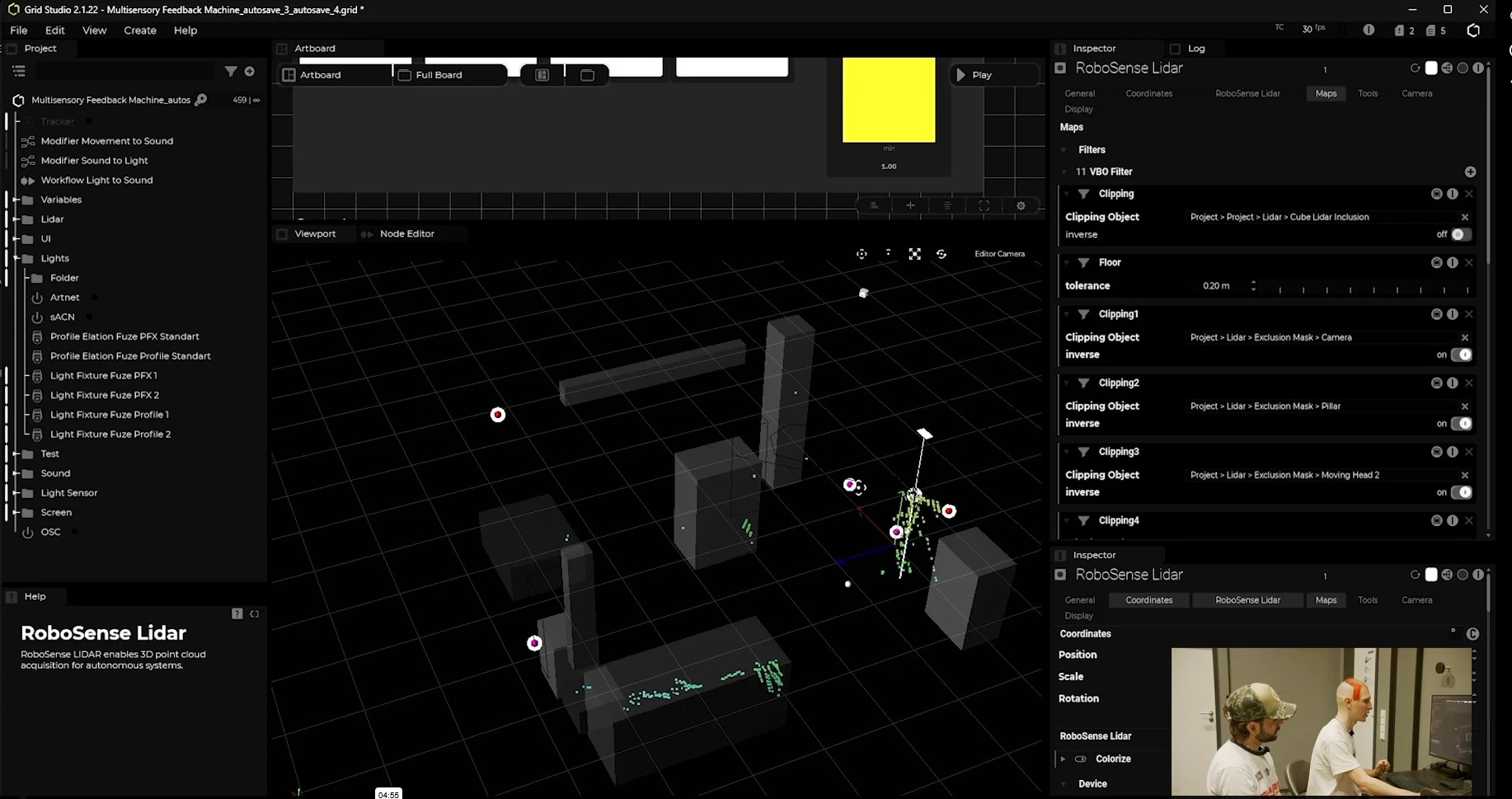
The final project is a room that feeds on itself. A performer moves, a LiDAR picks it up and SP Grid turns the speed of the movement into sound. The loudness of that sound drives the light. A phone camera reads the brightness, and that value sets how much the audio loop feeds back.
SP Grid does the translating between movement, sound and light. Ableton handles the audio, TouchDesigner reads the camera image and routes OSC. The moving heads run over DMX on Art-Net and sACN, with fixture profiles you see being made, and an iPad serves as the control surface.
The build took five days in the studio. You watch the room being split into stations, the lidar point cloud being cleaned until only the person is left, the moving heads being calibrated to follow the performer, and the finished performance.
Eight weeks
- 01Your first interactive networkWorkspace, first workflow, file structure.
- 02Designing for the person, not the systemArtboards, widgets, a control panel an operator can use.
- 03Real-time data3D scene, trackers, splines, OSC, reactive lighting.
- 04Timelines, triggers and cuesA karaoke set with OSC to TouchDesigner and a cue list.
- 05Designing for when you’re not therePython, winches, lasers, the state machine.
- 06Planning a feedback machineMovement to sound, sound to light.
- 07Building it on siteLidar clean-up, light calibration, the feedback loop.
- 08What’s new in SP GridWatchdog, Stream Deck, spatial tracking with lidar and camera.
Your instructors
 Sasha Abstraqt
 Belçim Yavuz
 Célestin Meunier
Get notified
Register to be notified when the course goes on sale.
With the support of Stage Precision
SP Grid and the TouchDesigner plugin
The new plugin from Stage Precision lets TouchDesigner receive SPNet data from Grid Studio. See a first glimpse at 19:00 at TouchDesigner Roundtable XXXIX, with TouchDesigner as previz and control layer for SP Grid, and learn SP Grid itself in our 8-week course. The evening starts at 17:00 with a tour of the Nebula exhibition: ten installations and 21 projectors in the historic bath house of Beelitz-Heilstätten. Free spots, reservation required.
Reserve a spot Watch the stream on YouTubeImage Credit : Xenorama